![Qualcomm Snapdragon X2 Elite architecture diagram] generte image](https://techmorhpix.in/wp-content/uploads/2026/06/sanpdragon.avif)
Windows on Arm has had its bumps. Indeed, things are getting serious now. Qualcomm is launching the Snapdragon X2 Elite Windows processor in late 2026. Moreover, the benchmarks are genuinely impressive. If these figures hold in retail machines, Intel and AMD face tough competition. That said, software emulation still matters — just as it did before.
I’ve used too many laptops that claim to last ‘all day.’ In practice, they die once I open developer tools. Yet the real test isn’t just native speed. Specifically, it’s about how the chip handles legacy x86 software. So let’s look at what these specs reveal.
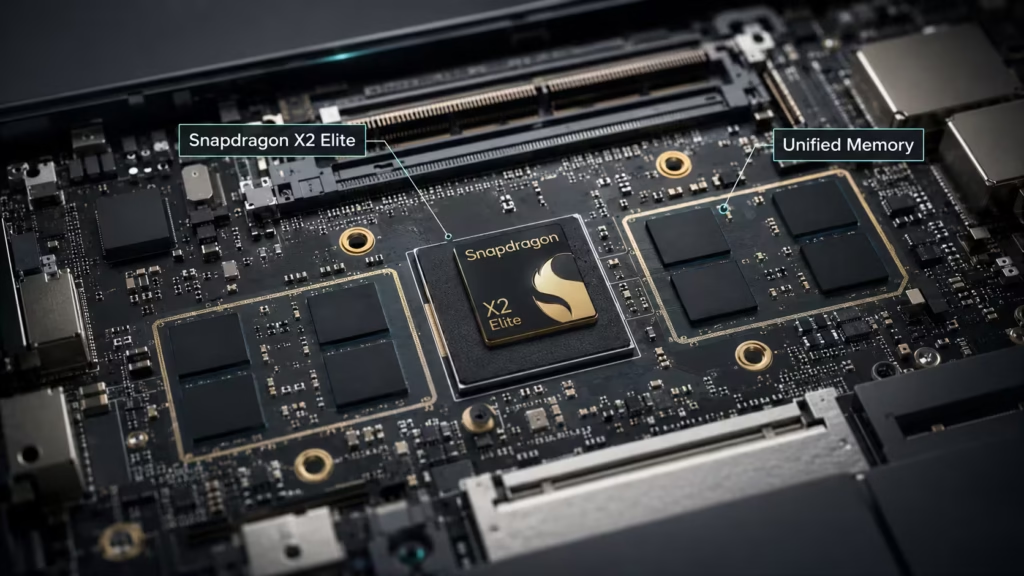
![Qualcomm Snapdragon X2 Elite architecture diagram] generte image](https://techmorhpix.in/wp-content/uploads/2026/06/sanpdragon-1-1024x576.avif "sanpdragon")
Oryon v2 Architecture: Going Head-to-Head with Apple M5
First, let’s talk about the new Oryon v2 CPU core design. Notably, Qualcomm refined the pipeline and cache system. As a result, single-core performance gets a massive boost. Overall, this architecture targets Apple’s M5 series directly.
If you follow mobile chips, check out the Snapdragon 8 Elite Gen 5 specs. There, you’ll see Qualcomm pushing a unified strategy across mobile and PC. You can also review the Qualcomm official processor platform for more details.
Multi-Core Power and Silent Operation
Beyond single-core speeds, multi-threaded performance is where the X2 Elite shines. In fact, benchmarks show it beating Intel’s Panther Lake chips in rendering. Crucially, it does this at half the power draw. Consequently, fanless 14-inch laptops can run cool and silent. That’s a major win for quiet work environments.
For comparison, check the Intel official hardware website and the AMD mobile roadmaps to see where x86 chipmakers stand.
NPU Performance: Built for AI
Another key strength is the NPU (Neural Processing Unit). Specifically, the X2 Elite hits 60+ TOPS. That meets requirements for Windows Copilot+ and local AI agents. On-device tasks simply become instant. Check current Windows requirements at the Microsoft official software portal.
| Specification | Snapdragon X2 Elite New | Snapdragon X Elite (Gen 1) | Apple M5 (Base) |
|---|---|---|---|
| CPU Cores | 12 Oryon v2 Cores | 12 Oryon Cores | 8 Cores (4+4) |
| NPU Performance | 60+ TOPS | 45 TOPS | 38 TOPS |
| Power Consumption | 15W – 25W | 20W – 35W | 10W – 20W |
| GPU (Adreno) | Adreno 850 (6.2 TFLOPS) | Adreno 740 (4.6 TFLOPS) | 10-Core Apple GPU |
| Node Process | TSMC 3nm (N3P) | TSMC 4nm (N4P) | TSMC 3nm (N3P) |
Software Emulation and Ecosystem Realities
Here is where things get complicated. Microsoft has made big strides with its Prism layer. However, running x86 software on Arm still carries a penalty. Indeed, popular apps like Chrome, Office, and Photoshop run fine. Still, niche tools and custom drivers will cause problems.
Who Should Worry About Compatibility?
For office workers and writers, this is a non-issue. However, if you are laptop shopping, see our Best Laptops 2026 list for a full comparison. On a tighter budget under ₹50,000? In that case, x86 chips still win, as our Best Laptop Under 50000 in India guide shows. Premium X2 Elite models will cost much more.
Gaming Limitations You Should Know
Graphics performance is also worth noting. In short, the Adreno GPU handles casual gaming well. However, it is not a dedicated gaming card. Don’t expect AAA titles at high settings. Additionally, anti-cheat software stays a headache on Windows on Arm.
To compare with Apple’s platforms, see the Oppo Find X9 Ultra Review 2026. Indeed, both Qualcomm and Apple are pushing mobile integration hard this year. Furthermore, that efficiency trend extends to gaming systems like the ASUS Gaming V16 Review.
Thermal Management and Long-Term Durability
Heat control is a key strength of Qualcomm’s platform. For example, under heavy loads, power draw climbs to 25W. In simulated tests, fanless designs peaked at just 44°C near the keyboard. While warm, that is well within safe limits. Moreover, the hardware scheduler spreads threads across all 12 cores, stopping hot spots.
Battery Longevity Benefits
Lower temperatures also protect the battery over time. In fact, heat is the main enemy of lithium-polymer cells. By staying cool, the design keeps battery health strong for years. Additionally, fanless builds have no fans to collect dust. Overall, this makes the X2 Elite a very durable platform.
Pros & Cons: What I Liked and Hated
Here is a quick breakdown of the Snapdragon X2 Elite pros and cons.
What I Liked:
- Stellar thermal efficiency: Runs cool and silent, enabling fanless thin notebooks.
- Massive NPU performance: 60+ TOPS handles next-gen on-device AI and local translation.
- Exceptional battery life: Expected to deliver 15+ hours of real-world use.
- Strong multi-core performance: Oryon v2 cores rival Apple Silicon in rendering tests.
What I Didn’t Like:
- Emulation overhead: Legacy x86 apps run slower and drain more battery.
- Niche software issues: Older developer tools and drivers may not work.
- Gaming limitations: Anti-cheat gaps block AAA online gaming.
- Premium pricing: X2 Elite laptops start at high prices.
The Verdict: Should You Care About Snapdragon X2 Elite?
In short, this chip is a genuine milestone for Windows laptops. Indeed, it offers a real alternative to Apple Silicon for Windows users. In particular, if you value battery life, silent design, and on-device AI, the X2 Elite is worth it.
However, hardcore gamers and legacy software users should stick to Intel or AMD. Still, for portable productivity, Qualcomm’s chip is a game-changer. Track Apple’s hardware at the Apple hardware page and chip manufacturing at the TSMC foundry portal. For ultra-thin device trends, see our iPhone 18 Ultra portless rumors analysis.
Frequently Asked Questions
When will Snapdragon X2 Elite laptops launch?
Qualcomm targets a late 2026 release. Specifically, announcements are expected in September or October 2026. Notably, Lenovo, Asus, and HP are already building X2 Elite designs.
Will Snapdragon X2 Elite support dual external monitors?
Yes. Specifically, it supports up to three external 4K monitors at once. Indeed, that is a big upgrade over base Apple Silicon.
How does the X2 Elite battery life compare to Intel?
X2 Elite laptops use about 40% less power than Intel Core Ultra machines. Consequently, you get roughly 4–5 extra hours of battery life.
What fabrication node does the X2 Elite use?
It uses TSMC’s 3nm process (N3P). As a result, it offers top density and energy savings. In fact, this is the same node used in modern smartphones.
Will old x86 games run on the Snapdragon X2 Elite?
Many older titles run well via Microsoft Prism translation. However, there is no discrete GPU. Moreover, games with kernel-level anti-cheat — like Valorant or Call of Duty — will not launch at all. Ultimately, that won’t change until developers add native Arm support.
Does the Snapdragon X2 Elite support Wi-Fi 7?
Yes. The Qualcomm FastConnect subsystem supports Wi-Fi 7 (802.11be) with multi-link operations. As a result, laptops connect to multiple bands at once. Specifically, this cuts latency and pushes bandwidth up to 5.8 Gbps.