- Full Specifications: Head-to-Head
- 1. Performance: Two Different Approaches to Speed
- 2. Camera: Philosophy Over Megapixels
- 3. Display: Samsung’s Privacy Display Is a Daily-Driver Feature
- 4. AI Features: Different Strengths
- 5. Battery: Samsung Has More, Charges Slower
- 6. The S Pen: Samsung’s Unmatched Differentiator
- 7. Ecosystem and Software
- India Pricing Summary
- Final Verdict
- Frequently Asked Questions
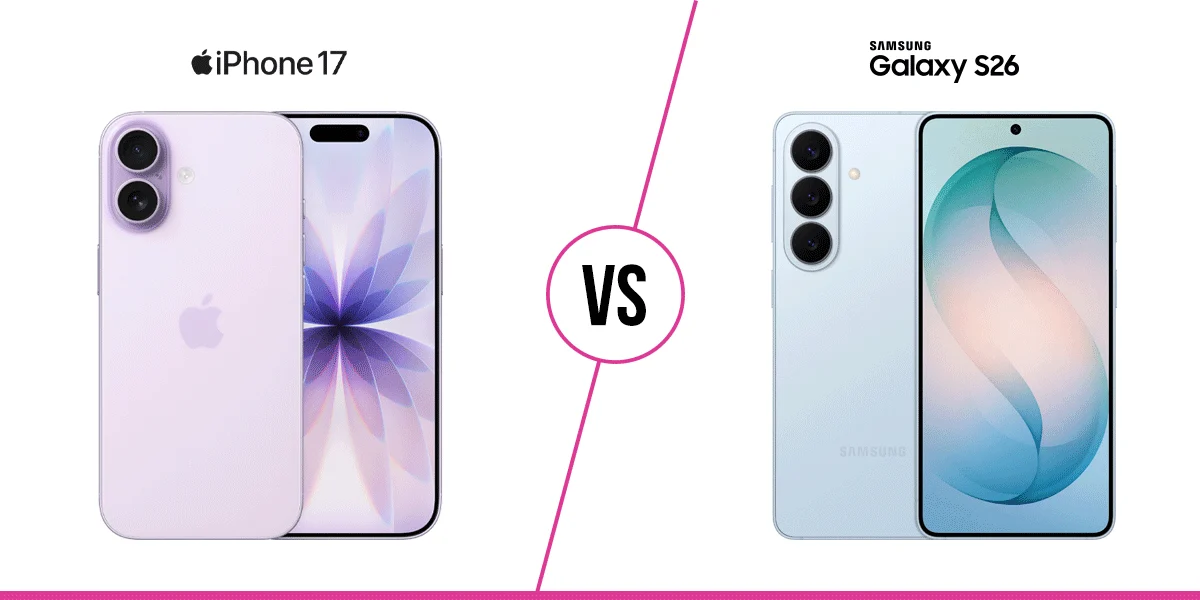
The two best phones money can buy in 2026 — and the debate between them is more nuanced than ever. The Samsung Galaxy S26 Ultra arrives with the world’s first Privacy Display, a 200MP camera system, a built-in S Pen, and Galaxy AI. The Apple iPhone 17 Pro Max brings consistent 48MP across all three cameras, ProRes RAW video, the A19 Pro chip, and Apple’s most complete implementation of Apple Intelligence to date. Neither is wrong. But depending on who you are, one is very clearly the right answer.
This is the complete, honest comparison — every meaningful category, with a clear verdict in each.
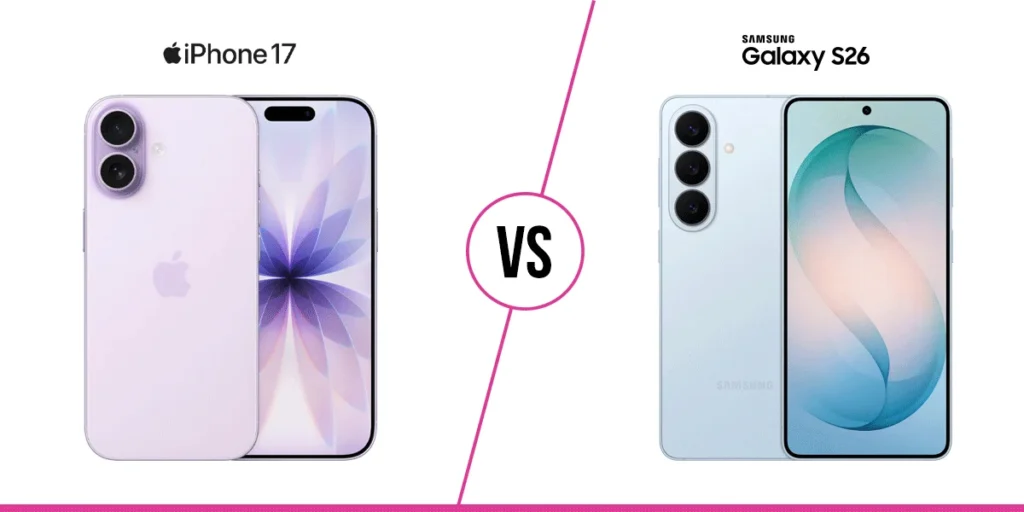
Full Specifications: Head-to-Head
| Specification | Samsung Galaxy S26 Ultra | Apple iPhone 17 Pro Max |
|---|---|---|
| Processor | Snapdragon 8 Elite Gen 5 “For Galaxy” | Apple A19 Pro (3nm) |
| Display | 6.9-inch QHD+ LTPO AMOLED, 120Hz + Privacy Display | 6.9-inch LTPO OLED, 120Hz ProMotion |
| Main Camera | 200MP (f/1.7, variable aperture) | 48MP Fusion (f/1.78) |
| Ultra-wide | 50MP | 48MP Fusion |
| Telephoto | 50MP periscope (5x optical) | 48MP periscope (4x optical) |
| Front Camera | 12MP | 18MP TrueDepth (Center Stage) |
| Video | 8K 30fps, 4K 120fps, Galaxy AI tools | 4K 120fps, ProRes, ProRes RAW, Dolby Vision |
| Battery | 5,000mAh | ~4,685mAh |
| Charging | 60W wired, 15W wireless | 30W wired, 25W MagSafe wireless |
| S Pen | Built-in ✅ | ❌ None |
| Privacy Display | Built-in pixel-level ✅ | ❌ None |
| AI Assistant | Galaxy AI (Gemini Intelligence) | Apple Intelligence (Siri AI) |
| Satellite | Emergency SOS (Qualcomm X85) | Emergency SOS + Satellite messaging (C1 modem) |
| OS Updates | 7 years (Android + security) | 6 years (iOS) |
| India Price (start) | ~₹1,29,999 | ~₹1,34,900 |
1. Performance: Two Different Approaches to Speed
Samsung uses the Snapdragon 8 Elite Gen 5 “For Galaxy” — a slightly overclocked variant exclusive to Galaxy flagships. Apple uses the A19 Pro, built in-house. In multi-core benchmarks, both chips perform nearly identically. In single-core performance — the metric most relevant for app launches, UI responsiveness, and AI tasks — the A19 Pro maintains a narrow but consistent lead of approximately 8–12%.
In practice: both phones feel instantaneous for every daily task. The difference becomes visible only in computationally intensive workloads — 4K video rendering, machine learning inference, or sustained gaming. For these, A19 Pro is slightly faster and runs cooler over extended periods.
Winner: iPhone 17 Pro Max — narrowly, in sustained peak performance.
2. Camera: Philosophy Over Megapixels
Samsung’s 200MP main camera versus Apple’s 48MP system is a deliberate choices, not an oversight. Apple’s unified 48MP approach across all three lenses creates exceptional consistency — switching between wide, ultra-wide, and telephoto produces images that feel like they came from the same camera. Samsung’s 200MP main gives extraordinary cropping flexibility, but telephoto switching can show colour and processing inconsistencies.
Stills Photography
Samsung wins on flexibility and zoom reach — the 5x optical periscope versus iPhone’s 4x is a real advantage at distance. In controlled daylight, Samsung’s 200MP files have more data to work with. In automatic (non-manual) shooting, iPhone’s computational photography tends to produce more natural colour reproduction while Samsung adds some HDR aggressiveness that can look slightly over-processed on faces.
Video
iPhone dominates video. ProRes RAW gives professional post-production flexibility that no Android phone matches. The Apple Log format, Dolby Vision recording, and the maturity of iPhone video stabilisation (Action Mode) make it the undisputed video tool. Samsung’s 8K recording is impressive for future-proofing but impractical for regular use — file sizes are enormous and few screens can display it.
Front Camera
iPhone’s 18MP Center Stage selfie camera versus Samsung’s 12MP is a meaningful upgrade — particularly for video calls where Center Stage auto-frames you as you move, and for selfie clarity in varied lighting.
Winner: Tie — Samsung for stills flexibility; iPhone for video.
3. Display: Samsung’s Privacy Display Is a Daily-Driver Feature
Both displays are outstanding. Samsung’s QHD+ resolution at 3088×1440 gives sharper text and images than iPhone’s standard OLED (though iPhone’s OLED calibration is exceptionally accurate). The decisive differentiator in 2026: Samsung’s exclusive built-in Privacy Display — which limits viewing angles at the pixel level without any brightness penalty. On public transport, in meetings, or at airports, this is a genuinely useful security feature every day.
Winner: Samsung Galaxy S26 Ultra — unique Privacy Display gives it a practical edge.
4. AI Features: Different Strengths
| AI Feature | Galaxy S26 Ultra (Galaxy AI) | iPhone 17 Pro Max (Apple Intelligence) |
|---|---|---|
| Live call translation | ✅ 16 languages offline | ✅ Via interpreter app |
| Cross-app automation | ✅ Gemini Intelligence | ✅ Siri AI (expanding) |
| On-device privacy | Hybrid on-device / cloud | On-device + Private Cloud Compute |
| Writing tools | ✅ Multi-app AI writing | ✅ System-wide writing tools |
| Photo AI editing | ✅ Photo Assist (advanced) | ✅ Clean Up, lighting tools |
| Note intelligence | ✅ Note Assist (S Pen + AI) | Basic |
| Proactive suggestions | ✅ Now Brief (very proactive) | ✅ Priority Mail, Focus |
Samsung’s Galaxy AI is broader in scope — more features, more proactive suggestions, deeper integration with Samsung’s own apps. Apple Intelligence is more private in design and more consistent — it works reliably in English and integrates tightly with iOS’s app permission system. Neither is clearly superior — it’s ecosystem preference.
5. Battery: Samsung Has More, Charges Slower
Samsung’s 5,000mAh is 7% larger than iPhone’s ~4,685mAh. Both phones provide all-day battery life under mixed use. The charging gap is where Samsung falls short in 2026: 60W wired versus iPhone’s 30W sounds like Samsung should win, but from 0–100%, Samsung takes ~65 minutes, while iPhone 17 Pro Max takes ~75 minutes — very close in practice because Apple’s chip is more efficient during charging.
Samsung leads on wireless charging: 15W Qi versus iPhone’s 25W MagSafe — and here Apple wins, with significantly faster wireless charging for MagSafe accessories.
Winner: Tie on battery life; iPhone on wireless charging speed.
6. The S Pen: Samsung’s Unmatched Differentiator
The built-in S Pen has no equivalent on iPhone. For professionals who handwrite notes, annotate PDFs, sketch diagrams, or sign digital documents — the S Pen at 0.7mm tip width and 2.8ms latency is the most precise stylus on any phone. Samsung Notes with AI note-structuring (available in One UI 9 beta) makes handwritten content actionable. This is the single feature that makes the S26 Ultra the only choice for a significant category of professional users.
Winner: Samsung Galaxy S26 Ultra — no competition from Apple here.
7. Ecosystem and Software
This is often the most personal factor. If you use Windows PCs, Android tablets, Galaxy Watch, and Galaxy Buds — the Samsung ecosystem integration is seamless. If your world is Mac, iPad, Apple Watch, and AirPods — iPhone’s handoff, AirDrop, iMessage, and Universal Clipboard integration is unmatched. Buy the phone that matches your existing ecosystem, not the one with the marginally better specs in isolation.
India Pricing Summary
| Variant | S26 Ultra Price | iPhone 17 Pro Max Price |
|---|---|---|
| Base storage | ₹1,29,999 (256GB) | ₹1,34,900 (256GB) |
| Mid storage | ₹1,44,999 (512GB) | ₹1,49,900 (512GB) |
| Max storage | ₹1,64,999 (1TB) | ₹1,69,900 (1TB) |
Final Verdict
| Buy the Samsung Galaxy S26 Ultra if… | Buy the iPhone 17 Pro Max if… |
|---|---|
| You use S Pen for notes, sketches, or annotation | You shoot ProRes video or are in the Apple ecosystem |
| Privacy Display matters for your daily commute | You prioritise single-core performance and thermal efficiency |
| You prefer Android and Samsung’s AI feature depth | You value privacy-first AI architecture |
| You want 7 years of guaranteed OS updates | You want the most consistent multi-lens camera system |
| You’re already in the Samsung/Google ecosystem | You’re an iPhone user upgrading from an older model |
Detailed benchmark data on GSMArena. India buy links on 91Mobiles.
Frequently Asked Questions
Which phone has better battery life — S26 Ultra or iPhone 17 Pro Max?
They’re very close in real-world mixed use — both comfortably last a full day. Samsung’s 5,000mAh capacity gives it a slight edge for heavy users. iPhone’s A19 Pro efficiency closes the gap. Under light use, both can stretch to 1.5 days.
Is the S26 Ultra good for video creators?
Good — but not as good as iPhone 17 Pro Max for professional video. Samsung’s Galaxy AI video tools are impressive, but iPhone’s ProRes RAW, Dolby Vision, and the maturity of its video stabilisation keep it ahead for professional post-production workflows.
Can I use an S Pen on the iPhone 17 Pro Max?
No — the iPhone 17 Pro Max doesn’t support any stylus input. Apple Pencil works only on iPad. The S Pen’s built-in integration with Galaxy hardware is exclusive to Samsung Galaxy devices.
Which has better resale value in India — Samsung or iPhone?
iPhone retains value better in India over a 2–3 year period. Premium Samsung flagships also hold value well but depreciate approximately 10–15% faster per year than equivalent iPhone models, based on historical India resale market data from OLX and Cashify.