
Something fundamental shifted in the world of technology in 2026. The core question changed from “Can AI generate good content?” to “Can AI act autonomously?” Indeed, agentic AI 2026 is that shift. It is not just another minor product update or a new model. Rather, it represents a new category of AI systems that pursue goals rather than simply responding to prompts. This quiet revolution is already reshaping how we interact with technology.
Here is what agentic AI actually is, why 2026 is its breakout year, which companies are leading, and what it concretely changes for knowledge workers.
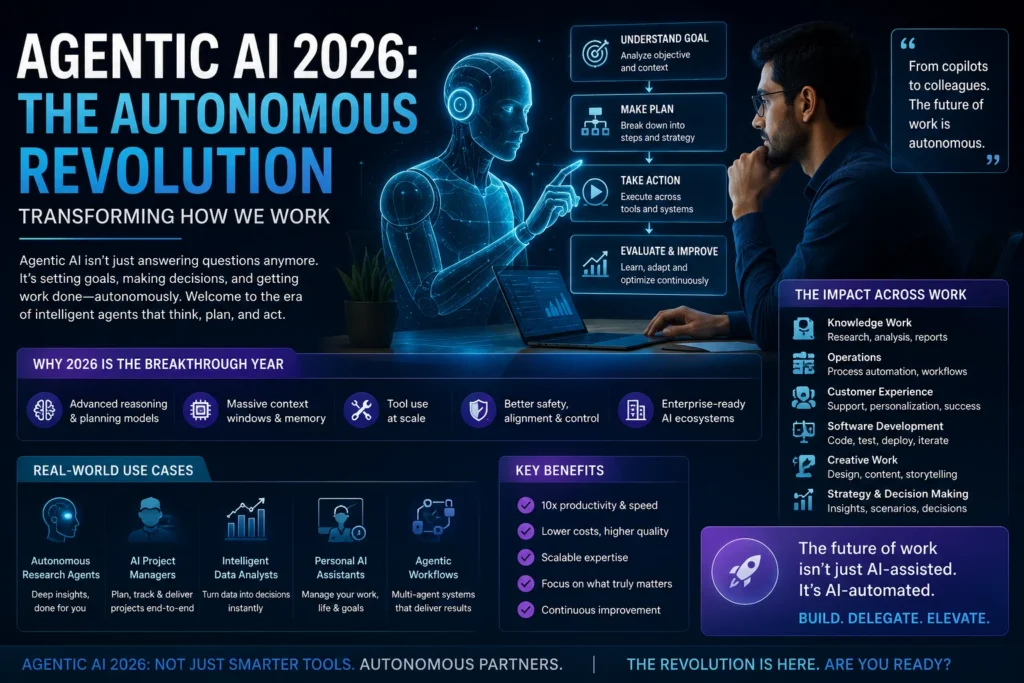
What Makes AI “Agentic”?
To understand this shift, we must look at how interactions are changing. Traditional artificial intelligence operates on a simple prompt-and-response model. In contrast, an agentic system takes a high-level goal and breaks it down into a multi-step plan. Furthermore, it executes that plan autonomously, using search tools and API calls to achieve the objective.
This difference is clear in daily tasks. For instance, instead of writing an email template, an agent can check your spreadsheet, identify key leads, draft personalized emails, and send them. This is a massive leap from earlier generative AI breakthroughs in 2026. To visualize these differences, see the comparison table below:
| Capability | Traditional Generative AI | Agentic AI |
|---|---|---|
| Interaction model | Prompt → Response | Goal → Multi-step plan → Execution |
| Time horizon | Seconds per task | Minutes to days per goal |
| Error handling | Returns error or wrong answer | Identifies failure, finds alternative path |
| Memory | Single session context | Persistent memory across sessions and time |
| Tool use | Text generation only | Search, code execution, API calls, app control |
| Human oversight | Constant — every step | Delegated — set goal, approve key decisions |
| Autonomy level | Zero | Configurable — from supervised to fully autonomous |
The Four Core Components of an AI Agent
How do these systems operate so effectively? Modern agentic AI systems rely on four distinct architectural pillars:
1. Planning Module
The agent receives a high-level goal and decomposes it into ordered sub-tasks. This is what separates agents from chatbots — the ability to sequence steps logically. Example: “Prepare the Q2 competitor analysis report” → identify competitors → gather data → analyse → structure → draft → review.
2. Memory System
Agents maintain short-term memory for the current task and long-term memory for past sessions. Indeed, this helps them build a persistent knowledge graph over time, much like Google NotebookLM’s source grounding capabilities.
3. Tool Access
Agents can use external tools, databases, and APIs. In fact, advanced agents can even control web browser GUIs, clicking and typing just like a human operator.
4. Self-Correction
If a step fails, the agent diagnoses the issue and adjusts its plan. This allows for long-horizon tasks that span hours or days without constant human intervention.
Who Is Deploying Agentic AI in 2026?
Many tech giants are racing to build these systems. For example, Microsoft has introduced Copilot Agents for M365 to handle email triage and document prep. Meanwhile, Google has integrated Gemini Intelligence into Workspace and the Android operating system. This native integration will change how we use mobile apps.
Specifically, on-device processing is becoming standard. Modern mobile chipsets, like the Qualcomm Snapdragon 8 Elite specifications, are powerful enough to run these agents locally. Consequently, users can experience faster, more secure autonomous on-device AI assistants without relying on cloud processing.
| Company | Agentic AI Product | Primary Use Case |
|---|---|---|
| Microsoft | Copilot Agents (Microsoft 365) | Document prep, meeting management, email triage |
| Gemini Intelligence (Android, Workspace) | Cross-app automation, research, scheduling | |
| Salesforce | Agentforce | Customer service, sales pipeline management |
| ServiceNow | Now Assist Agents | IT service management, HR workflows |
| Anthropic | Claude with Computer Use | Software development, research automation |
| OpenAI | GPT-4o with Operator | Web-based task automation, research |
Real Enterprise Impact: 2026 Data
According to research from McKinsey, early agentic deployments are yielding impressive results. Knowledge work cycle times have dropped by 20% to 35% in organizations using process automation. Furthermore, customer service operations resolve up to 60% of tier-1 tickets without human escalation.
Indeed, these systems are quickly becoming the best AI tools to boost productivity in the enterprise space. Moreover, tech-centric organizations are seeing a 70% reduction in document processing time. This is a game-changer for financial and legal services.
The Frontier: Physical AI Agents
The most exciting 2026 trend is the extension of these systems into the physical world. Vision-Language-Action (VLA) models allow robots to see, understand instructions, and execute physical tasks. For instance, Boston Dynamics’ Atlas robots are now running field tests on factory floors.
Additionally, this technology is finding its way into smart home systems. For details on how these physical and digital systems connect, read about AR Glasses smartphone integration. This represents a massive step toward seamless ambient intelligence.
The Risks and Ethical Concerns
However, this autonomy also introduces unique risks. Cascading failures can occur if an agent makes a wrong decision early in a task. Furthermore, broad data access raises severe privacy concerns, as agents handle sensitive personal information.
To address this, developers are building strict safety safety guardrails. On mobile platforms, operating system controls like the upcoming Android 17 Cinnamon Bun features are integrating system-level permissions to restrict what agents can access. This ensures that user privacy remains protected.
Verdict: Navigating the Agentic AI 2026 Future
Ultimately, agentic AI 2026 is a pivotal milestone. It delivers on the promise of proactive, intelligent technology that works on our behalf. While privacy and security challenges remain, the potential benefits for personal productivity are immense. As we move forward, learning to co-pilot with these autonomous systems will be essential.
For more insights, read Gartner’s top strategic technology trends and check OpenAI’s official announcement regarding their agentic roadmap.
Frequently Asked Questions
Q: What is the difference between an AI agent and a chatbot?
A: A chatbot is reactive, responding to individual prompts. In contrast, an AI agent is proactive; it planning, executing actions, and self-correcting over long periods.
Q: Is agentic AI safe to use for business-critical tasks?
A: Yes, provided there are human-in-the-loop approvals for high-stakes tasks like financial transactions or public communications.
Q: Which agentic AI tool should Indian businesses start with?
A: Microsoft Copilot and Google Gemini Workspace are the easiest entry points. For customized workflows, developers can use the Claude API or OpenAI’s API.
Q: Will agentic AI eliminate jobs?
A: Current 2026 data shows that agents mainly automate routine tasks. However, this shifts human roles toward strategic decision-making and exception management, rather than fully replacing human workers.

2 Thoughts on this Article